
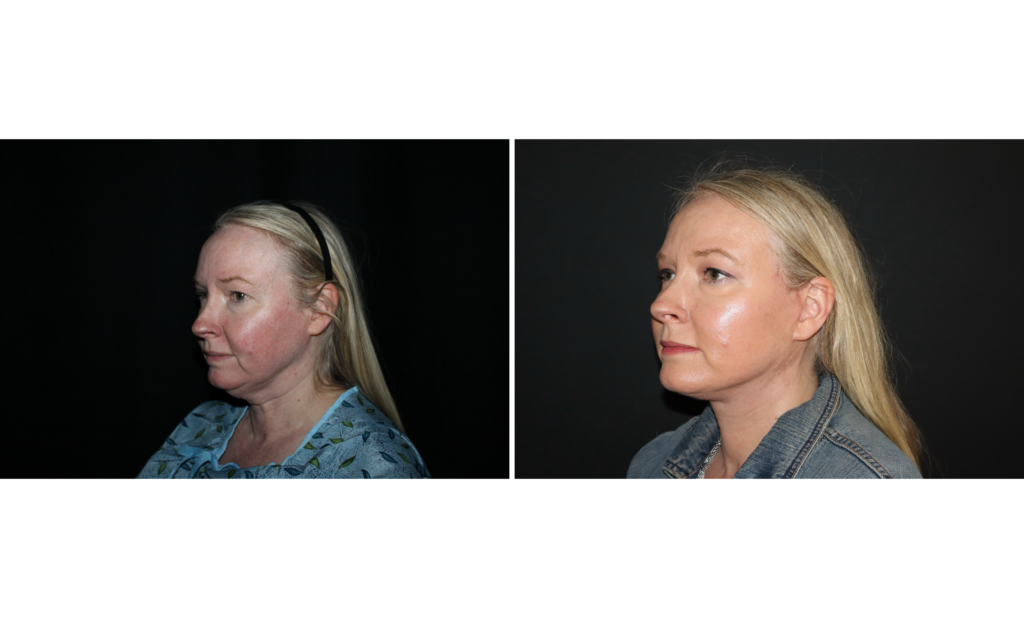
You feel as energetic and vibrant as you did a decade ago — but the face looking back at you in photos tells a different story. The jawline that was once crisp has softened into jowls. The cheeks look a little flatter. There’s loose skin and banding along the neck that no serum, filler, or amount of sleep seems to fix. If that sounds familiar, you’ve probably started researching facelifts and run into a term that comes up again and again: the deep plane facelift.
At Crantford Costa Plastic Surgery in downtown Charleston, the deep plane facelift has become one of the most-requested facial rejuvenation procedures for patients across the Lowcountry. It’s prized for one reason above all: when it’s done well, it doesn’t look “done” at all. Instead of a tight, pulled appearance, a deep plane facelift restores the natural contours of a younger face — and the results tend to last longer than a traditional facelift.
Below, board-certified plastic surgeon Dr. Clayton Crantford breaks down what a deep plane facelift actually is, how it differs from a SMAS facelift, who makes a good candidate, what recovery looks like, and what you can expect to invest here in Charleston, SC.
What Is a Deep Plane Facelift?
A deep plane facelift is an advanced facelift technique that lifts and repositions the deeper structural layers of the face — not just the skin. As we age, it isn’t only the skin that descends. The muscle and connective-tissue layer beneath it (called the SMAS, or superficial musculoaponeurotic system) loosens, and the ligaments that anchor your cheeks and jawline stretch and give way. This is what creates jowls, deep folds, and a heavy, tired-looking midface.
In a deep plane facelift, Dr. Crantford works in the plane beneath the SMAS to carefully release those tethering ligaments. The skin, fat, and muscle are then lifted and repositioned together as a single composite unit — vertically, the way the face naturally ages downward. Because everything moves as one and the skin is never pulled tight to do the lifting, the result is a refreshed, rested look with natural movement and expression, rather than the wind-blown appearance associated with older techniques.
Deep Plane Facelift vs. SMAS Facelift: What’s the Difference?
Short answer: a traditional SMAS facelift tightens the superficial muscle layer and the skin separately, while a deep plane facelift releases the facial ligaments and moves the skin, fat, and muscle together as one unit — which generally produces a more natural midface and longer-lasting results.
Both are excellent, time-tested procedures. The right one for you depends on your anatomy, the degree of aging, and your goals. Here’s how they compare:
- What’s moved — A SMAS facelift tightens or folds the SMAS layer and re-drapes the skin over it. A deep plane facelift releases the retaining ligaments and lifts the skin, fat, and SMAS together as one composite layer.
- Best candidates — SMAS techniques are well suited to mild-to-moderate aging and jowl correction. The deep plane approach shines for moderate-to-advanced aging, midface descent, and volume loss in the cheeks.
- How natural it looks — Because a deep plane lift doesn’t rely on skin tension, there’s less risk of a “pulled” look. Published patient-satisfaction data has favored the deep plane technique.
- How long it lasts — SMAS results typically last around 5 to 10 years, while deep plane results commonly last 10 to 15 years or more, because the lift is supported by the deeper, stronger structures of the face.
Dr. Crantford performs the full range of facelift techniques in Charleston — from a mini facelift for early changes, to SMAS, to a deep plane facelift, often combined with a neck lift for full lower-face and neck rejuvenation. The goal is never to apply a one-size-fits-all operation, but to match the technique to your face.
What Areas Does a Deep Plane Facelift Improve?
A deep plane facelift targets the lower two-thirds of the face and, when combined with a neck lift, the neck. It’s especially effective for:
- Jowls — restoring a clean, defined jawline by repositioning sagging cheek tissue.
- Midface and cheeks — lifting flattened, deflated cheeks back to a more youthful, rounded position.
- Nasolabial folds and marionette lines — softening the deep creases that run from the nose to the mouth and chin.
- Jawline and neck — paired with a neck lift, it addresses sagging skin, vertical banding, and a loss of the crisp angle beneath the chin.
It’s just as important to know what a facelift doesn’t do. A deep plane facelift repositions tissue — it doesn’t resurface the skin, erase fine wrinkles, or treat sun damage and discoloration. It also doesn’t lift the brows or rejuvenate the eyes. Many patients pair their facelift with brow or eyelid surgery and skin treatments such as laser resurfacing for a complete, harmonious result. Dr. Crantford will map out the right combination during your consultation.
Am I a Good Candidate for a Deep Plane Facelift?
The best candidates for a deep plane facelift generally share a few characteristics:
- Visible lower-face and neck aging — moderate to advanced jowling, midface descent, deep folds, or neck laxity that creams and non-surgical treatments can no longer keep up with.
- Generally in the 40s to 70s — though the technique benefits both younger patients seeking prevention of further descent and older patients with realistic goals.
- Good overall health — non-smokers (or those willing to stop well before and after surgery) in stable health heal more predictably and have lower complication rates.
- Realistic expectations — you want to look like a refreshed, well-rested version of yourself, not like a different person. This aligns with our philosophy of enhancement, not transformation.
The only way to know with certainty whether a deep plane facelift — or a different technique — is right for you is an in-person evaluation. Browsing our before-and-after gallery can also help you set realistic expectations before you come in.
How Long Do Deep Plane Facelift Results Last?
Short answer: most patients enjoy their deep plane facelift results for 10 to 15 years, often longer. Because the lift is anchored to the deep, structural layers of the face rather than the skin, the correction holds up far better over time than a skin-only or traditional SMAS lift.
It’s worth setting expectations honestly: a facelift doesn’t stop the clock. Your face will continue to age naturally after surgery. But it ages from a younger starting point — meaning you’ll consistently look years younger than you would have without the procedure. Protecting your investment with good skincare, sun protection, and occasional non-surgical maintenance keeps results looking their best.
What Is Recovery Like After a Deep Plane Facelift?
Short answer: most patients feel ready to return to social activities in about two to three weeks, with full results emerging over the following months as swelling settles. Here’s a general timeline:
- Days 1–7 — swelling and bruising peak in the first few days and then begin to improve. Most patients are surprised by how manageable the discomfort is; it’s more tightness and pressure than sharp pain. Sutures and dressings are typically removed during the first week.
- Weeks 2–3 — most visible bruising and major swelling subside. Many patients feel comfortable returning to desk work and low-key social outings around this point, often with light makeup covering any residual discoloration.
- Weeks 4–6 — you’ll feel increasingly like yourself, and strenuous exercise is generally cleared by around six weeks. Residual tightness and subtle swelling continue to fade.
- Months 3–12 — final results refine as deep tissues fully settle and any remaining swelling resolves.
To make recovery as smooth and comfortable as possible, our practice uses Enhanced Recovery After Surgery (ERAS) protocols designed to minimize discomfort and downtime. You’ll go home with detailed instructions and a clear follow-up schedule so you’re supported at every step.
How Much Does a Deep Plane Facelift Cost in Charleston, SC?
Short answer: in the Charleston area, a deep plane facelift commonly ranges from roughly $15,000 to $30,000, depending on the complexity of your procedure and whether it’s combined with a neck lift or other treatments. Nationally, deep plane facelifts often fall between $20,000 and $40,000.
Several factors influence your individual cost:
- The extent of the procedure — a deep plane facelift alone versus a facelift combined with a neck lift, brow lift, or fat grafting.
- Surgical facility and anesthesia fees — performed in our Joint Commission–accredited facility with board-certified anesthesia providers for your safety.
- Surgeon experience and technique — the deep plane facelift is a technically demanding procedure, and surgeon expertise matters.
Because every face and every plan is unique, the only way to get an accurate number is a personalized quote at your consultation. We’re transparent about pricing and offer financing options to help make your procedure more accessible.
Why Choose Crantford Costa Plastic Surgery for Your Deep Plane Facelift?
A deep plane facelift is one of the most advanced procedures in facial plastic surgery, and your choice of surgeon makes all the difference. Dr. Clayton Crantford is a board-certified plastic surgeon and Diplomate of the American Board of Plastic Surgery, with more than 15 years of experience and fellowship training in complex aesthetic procedures. He was voted Best Plastic Surgeon in Charleston in 2024.
Patients across the Lowcountry — from Mount Pleasant, Daniel Island, and Isle of Palms to Summerville, Kiawah, and Sullivan’s Island — choose our downtown Charleston practice for our meticulous technique, our Joint Commission–accredited surgical facility, advanced Crisalix 3D imaging, ERAS rapid-recovery protocols, and a patient-centered philosophy built on honesty and a genuine commitment to natural-looking results. Our guiding principle is simple: enhancement, not transformation.
Schedule Your Deep Plane Facelift Consultation in Charleston, SC
If you’re ready to learn whether a deep plane facelift is right for you, the best next step is a one-on-one consultation where Dr. Crantford can evaluate your anatomy, discuss your goals, and build a personalized plan — including a preview of your potential results with 3D imaging.
Ready to take the next step toward a more refreshed, youthful appearance? Call (843) 755-6591 or request a consultation online.
Frequently Asked Questions About Deep Plane Facelifts
Is a deep plane facelift worth it?
For the right candidate, many surgeons and patients consider it the gold standard of facial rejuvenation. It addresses the deeper causes of facial aging, produces natural-looking results without a pulled appearance, and commonly lasts 10 to 15 years — longer than skin-only or traditional SMAS lifts. Whether it’s worth it for you depends on your anatomy and goals, which is what a consultation is designed to determine.
How painful is deep plane facelift recovery?
Most patients report far less pain than they expect — typically a sensation of tightness and pressure rather than sharp pain, well controlled with medication. Our ERAS rapid-recovery protocols are specifically designed to minimize discomfort and speed healing.
Will a deep plane facelift look natural?
Yes — looking natural is the entire advantage of the technique. Because the deep plane facelift repositions deeper tissues and doesn’t rely on pulling the skin tight, it avoids the over-tightened, “windswept” look. The aim is a rested, younger version of you that still moves and expresses naturally.
What’s the difference between a deep plane facelift and a mini facelift?
A mini facelift is a less extensive procedure that tightens the SMAS through smaller incisions, ideal for early or mild jowling with shorter downtime. A deep plane facelift is a more comprehensive operation that releases the facial ligaments and lifts deeper structures, making it better suited to moderate-to-advanced aging and delivering longer-lasting results.
At what age should you get a deep plane facelift?
There’s no single “right” age. Most patients are in their 50s and 60s, but candidates in their 40s and 70s see excellent results too. What matters more than age is the degree of facial aging, your overall health, and your goals. A consultation with Dr. Crantford is the best way to determine the ideal timing for you.

Dr. Clayton Crantford is a board-certified plastic surgeon and Diplomate of the American Board of Plastic Surgery (ABPS), co-founder of Crantford Costa Plastic Surgery in downtown Charleston, SC. With more than 15 years of experience and fellowship training in complex aesthetic and reconstructive procedures, his areas of expertise include breast augmentation with Motiva implants, facelifts, blepharoplasty, rhinoplasty, tummy tucks, mommy makeovers, and liposuction.
Dr. Crantford integrates advanced tools such as Crisalix 3D imaging and ERAS Rapid Recovery protocols to deliver natural-looking results with smoother recoveries. His surgical facility is accredited by The Joint Commission, meeting the highest national standards for patient safety.
Voted Best Plastic Surgeon in Charleston in 2024, Dr. Crantford is known for his meticulous technique and a warm, patient-centered philosophy of "enhancement, not transformation."


